


 Customer service
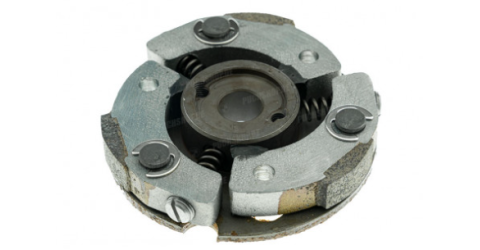
Puch Maxi E50 clutch explained: function, adjustment and clutch housing play
The Puch Maxi E50 uses an automatic centrifugal clutch. That means the moped does not have a manual gearbox: as the engine speed rises, the clutch shoes move outward, grip the clutch housing and transfer power to the secondary shaft and front sprocket.
A good E50 clutch setup is not only about choosing the right clutch. The clutch housing, plain bearing, shim rings, clutch oil, spring tension and clutch type all need to work together. If one of these parts is worn or incorrectly adjusted, your Puch can slip too much, engage too early, make noise, wear the sprockets or feel weak when pulling away.
How does a Puch Maxi E50 clutch work?
The E50 clutch is a wet centrifugal clutch. When the engine is idling, the clutch shoes sit inward and the moped stays still. As the engine revs increase, centrifugal force pushes the clutch shoes outward. When the shoes touch the inside of the clutch housing, the clutch begins to transfer power.
The clutch housing rotates around the crankshaft and drives the secondary shaft. The front sprocket is mounted on the secondary shaft, which then sends power to the rear wheel through the chain. Between the clutch housing and crankshaft sits a plain bearing or bronze bushing. This bearing is very important because it allows the clutch housing to rotate smoothly.
The E50 clutch usually contains the following main parts:
- Clutch base plate
- Clutch shoes or clutch segments
- Clutch springs
- Spring adjustment screws
- Clutch housing
- Plain bearing or bronze bushing
- Shim rings and circlip
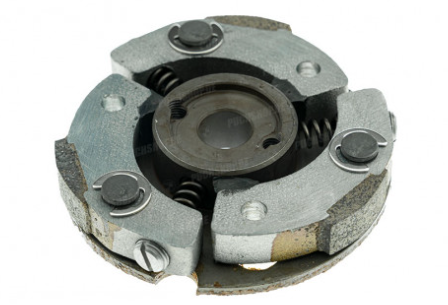
Pedal-start and kickstart Puch E50 clutch types
There are two main E50 clutch versions: the pedal-start clutch and the kickstart clutch. The correct version depends on the engine type.
| Clutch type | How to recognise it | Important note |
|---|---|---|
| Pedal-start clutch | Has friction lining on the back of the clutch base plate | The pressure plate pushes against the lining to turn the crankshaft during starting. |
| Kickstart clutch | No friction lining on the back of the clutch plate | The kickstart mechanism drives the crankshaft through a pinion instead of using the rear clutch lining. |
| 2-shoe clutch | Two clutch segments | Common on older standard setups (Maxi S or N). |
| 3-shoe clutch | Three clutch segments | Offers more contact area inside the clutch housing. |
Always check whether your engine is pedal-start or kickstart before ordering a clutch, clutch housing or pressure plate. The parts may look similar, but the starting system changes what the clutch needs to do.
Back to topClutch housing play, plain bearings and shim rings
Many E50 clutch problems come from play in the clutch housing. Even with a rebuilt engine, a new clutch housing or a new crankshaft, there can still be movement if the plain bearing, shim rings or clutch housing position are not correct.
| Check | Problem sign | Solution & Replacement Parts |
|---|---|---|
| Plain bearing / bushing | Housing rocks or moves visibly | Replace the plain bearing or upgrade to a better bushing. Shop PSR clutch bearing bushing |
| Axial play | Housing moves in and out visibly | Use the correct shim rings to remove excess movement. Shop E50 shim washer kit |
| Circlip / Seeger ring | Missing, damaged or not seated correctly | Replace or refit the correct circlip before running the engine. Shop clutch-side circlip Shop front-side circlip |
You can find E50 clutch parts, clutch housings and related parts in the Puch Maxi E50 clutch parts category. If the clutch housing rocks on the crankshaft, check the PSR sinter aluminium clutch bearing bushing. For correcting clutch housing side play, use the assorted E50 shim washer kit. If the retaining clip is worn, missing or damaged, replace it with the correct clutch-side circlip or front-side clutch circlip. For removal and installation work, the clutch and flywheel locking tool helps hold the clutch or flywheel safely while loosening or tightening the nut. If the clutch needs to come off the crankshaft, use the clutch puller / inside rotor puller to remove it cleanly without prying against the engine parts.
Back to topHow do you adjust a Puch E50 clutch?
A Puch E50 clutch is adjusted by changing the spring preload with the adjustment screws. Screwing the adjustment screws in increases spring tension. Unscrewing the adjustment screws reduces spring tension. This changes how much the clutch slips and when the clutch segments begin to drive the clutch housing.
With more spring tension, the clutch shoes need more engine speed before they can move outward and grip the clutch housing. This makes the clutch engage later. Because the engine side and clutch housing side have a greater speed difference, especially when pulling away from a standstill, the clutch slips more before both parts reach the same speed.
Interactive clutch engagement simulator
Select your spring strength and adjust the fine-tuning slider to see how spring preload changes the estimated engagement RPM of your Puch E50 clutch.
Spring strength data is based on the Puch E50 clutch spring set. The +RPM values indicate the estimated increase compared with stock E50 clutch springs. This simulator is a visual tuning guide, not an exact RPM calculator. Real engagement depends on clutch shoe weight, lining condition, clutch oil, spring condition, housing wear, engine torque, rider load and temperature. Always confirm the final setup with test rides and check for overheating, grabbing or excessive slip.
Basic adjustment method
A good basic setting is to make sure all spring adjustment screws are set evenly. On many replacement clutches, the screws can be set approximately flush with the clutch shoe surface as a starting point.
Back to topStandard, reinforced and custom Puch E50 clutches
The best clutch depends on the power level of your setup. A standard 25 km/h or 45 km/h Puch engine does not need the same clutch as a tuned 50cc, 70cc or high-rpm setup.
| Setup type | What to watch | Recommended Parts |
|---|---|---|
| Standard engine | Clean engagement, no visible housing play, correct oil and even screw adjustment. | Good original-style clutch with stock spring strength Shop standard clutches |
| Mild 50cc or sport setup | A little later engagement can help the engine reach its useful rpm range without creating too much heat. | Standard or reinforced clutch with slightly stronger springs Shop E50 clutch spring set |
| 70cc or high-rpm setup | Check bushing wear, shim position, reinforcement plate clearance and clutch temperature more often. | Reinforced or custom clutch with strong springs, shim rings and housing support Shop racing clutches Shop E50 shim washer kit Shop clutch puller |
When the clutch is upgraded, the rest of the clutch system becomes more important. A stronger spring setup can make the clutch work harder, so the clutch housing, bearing bushing, shim rings and clutch oil should all be in good condition. For clean removal, use the clutch puller / inside rotor puller rather than prying against the clutch or crankcase.
Ready to upgrade your Puch E50 clutch?
Browse standard clutches, race clutches, housings, spring sets, shim washers, circlips, locking tools and clutch pullers needed for correct clutch work.
Shop all Puch E50 clutches & parts Shop clutch bearing bushing Shop E50 shim washer kit Shop clutch-side circlip Shop front-side circlip Shop clutch locking tool Shop clutch puller Fast shipping • Large stock • Expert supportFAQ: Puch Maxi E50 clutch adjustment
How do I know if my Puch E50 clutch housing has too much play?
If the clutch housing moves visibly from side to side or in and out, there is too much play. A tiny amount of movement that can be felt but not clearly seen is usually normal. Visible play should be checked because it can cause noise and sprocket wear.
Should I replace the plain bearing when fitting a clutch housing?
Yes, it is usually smart to replace the plain bearing or bushing if there is play, noise or visible wear. A fresh bushing often removes most of the clutch housing play and helps the housing rotate smoothly.
Which way do I turn the Puch E50 clutch screws for more slip?
For more slip, screw the adjustment screws in further. This increases spring tension, makes the clutch engage later and creates more slip before the clutch and housing reach the same speed.
Which way do I turn the Puch E50 clutch screws for less slip?
For less slip, unscrew the adjustment screws further. This reduces spring tension, makes the clutch engage earlier and creates a more direct engagement with less slip.
Do stronger clutch springs make my Puch faster?
Stronger springs do not directly create more engine power. They change the clutch engagement moment. On a tuned engine, this can help the engine pull away in a better rpm range, but too much spring tension can create heat, excessive slip and poor rideability.