


 Customer service
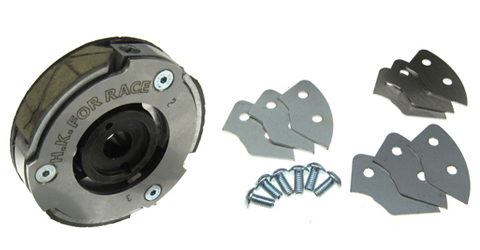
Puch Maxi E50 HK/GP clutch adjustment
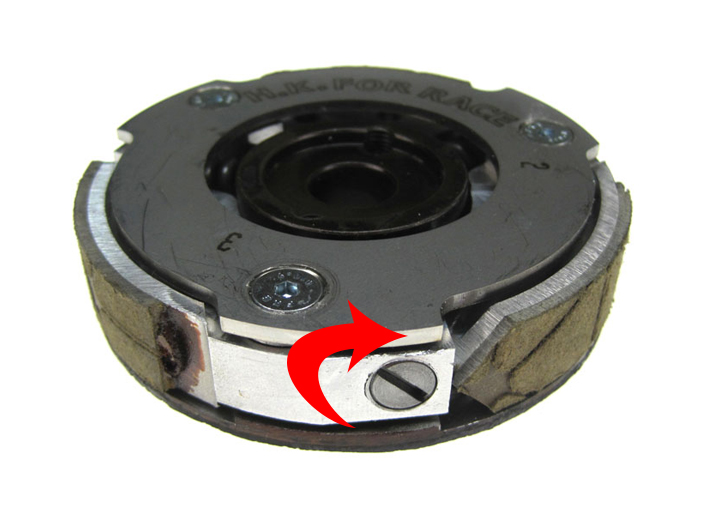
The HK/GP clutch for a Puch Maxi E50 is set at around 7500 rpm as standard, without any extra weight. Turning the adjusting screw clockwise raises the engagement speed. Adding extra weight lowers the engagement speed.
In this guide, you can see how the adjustment works, how much effect the adjusting screw has, and which engagement speeds you can roughly expect with different weight combinations. Use the table as a practical tuning reference, because the exact engagement rpm can vary depending on the engine, spring condition, clutch setup, oil and overall build.
Basic HK/GP clutch adjustment
Without extra weight, the clutch is set to engage at around 7500 rpm. This means the clutch starts to bite around this engine speed and transfers power from the crankshaft through the clutch to the clutch housing.
A higher engagement speed can be useful on a sport or high-rpm setup, because the engine can rev higher before the clutch fully grabs. A lower engagement speed can work better for a milder setup or when you want the moped to pull away earlier.
Adjusting the screw
The adjusting screw lets you fine-tune the engagement speed of the clutch. Always adjust in small steps and check the result afterwards with a tachometer if possible.
- Turn clockwise: the engagement speed becomes higher.
- 1/4 turn clockwise: roughly 200 rpm higher.
- Turn counterclockwise: the engagement speed becomes lower.
Extra weight adjustment table
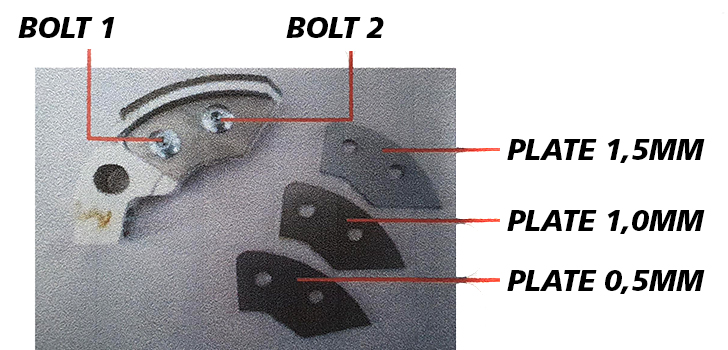
Adding extra weight to the clutch lowers the engagement speed. When extra weight is fitted, it is normally not necessary to change the adjusting screw setting. Use the table below as a reference for the different combinations.
| Weight combination | Engagement speed | Difference from basic setup |
|---|---|---|
| Adjusted without extra weight | 7500 rpm | Basic setup |
| Bolt 1 added | 7200 rpm | -300 rpm |
| Bolt 2 added | 6900 rpm | -600 rpm |
| Bolt 1 and 2 added | 6800 rpm | -700 rpm |
| 0.8 mm plate and bolt 1 added | 6500 rpm | -1000 rpm |
| 1.0 mm plate and bolt 1 added | 6300 rpm | -1200 rpm |
| 1.5 mm plate and bolt 1 added | 6100 rpm | -1400 rpm |
| 0.8 mm plate and bolt 2 added | 6200 rpm | -1300 rpm |
| 2.0 mm plate and bolt 2 added | 6000 rpm | -1500 rpm |
| 1.5 mm plate and bolt 2 added | 5800 rpm | -1700 rpm |
| 1.5 mm plate, bolt 1 and bolt 2 added | 5600 rpm | -1900 rpm |
Practical tuning tips
Always tune the clutch step by step. Start with the basic setting, test how the moped launches, and only then change the adjusting screw or add weight. This keeps the tuning process clear and prevents you from changing too many things at once.
Also keep the rest of your setup in mind. Cylinder choice, exhaust, carburettor, gearing and clutch oil all affect how the moped pulls away from a standstill. A high-rpm race setup often needs a different clutch setting than a standard street setup.
Back to topFAQ: Puch Maxi E50 HK/GP clutch adjustment
What does the adjusting screw on the HK/GP clutch do?
The adjusting screw changes the clutch engagement speed. Turning it clockwise raises the engagement speed. Turning it counterclockwise lowers the engagement speed.
How much does the rpm change per 1/4 turn?
A 1/4 turn clockwise raises the engagement speed by roughly 200 rpm. Use this as a guideline and always check the result in practice.
What happens when I add extra weight?
Extra weight lowers the clutch engagement speed. This makes the clutch bite earlier. The table in this guide shows the approximate rpm for each weight combination.
Can I turn the adjusting screw more than 1 full turn clockwise?
No. Do not turn the adjusting screw more than 1 full turn clockwise. Too much spring tension can damage the spring and reduce spring force, making the clutch less reliable.