


 Customer service
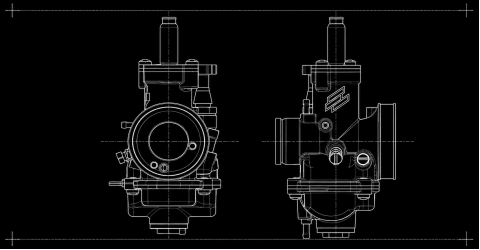
Polini CP carburetor explained: which size do you need for your Puch?
A Polini CP carburetor is a compact, performance-focused carburetor for tuned Puch mopeds. It controls the fuel and air mixture your engine needs to start, idle, accelerate and pull cleanly at full throttle. The correct CP size depends on your cylinder, exhaust, intake manifold, air filter and how you want the engine to behave.
At Puchshop, we sell several Polini CP versions: Polini CP EVO spigot carburetors in 19mm, 21mm and 24mm, Polini CP clamp carburetors in 15mm, 17.5mm, 19mm and 21mm, Polini CP spigot carburetors in 17.5mm, 19mm and 21mm, a 21mm clamp cable choke version with air filter set, a 21mm spigot version with air filter, and a 17.5mm replica spigot option.
What is a Polini CP carburetor?
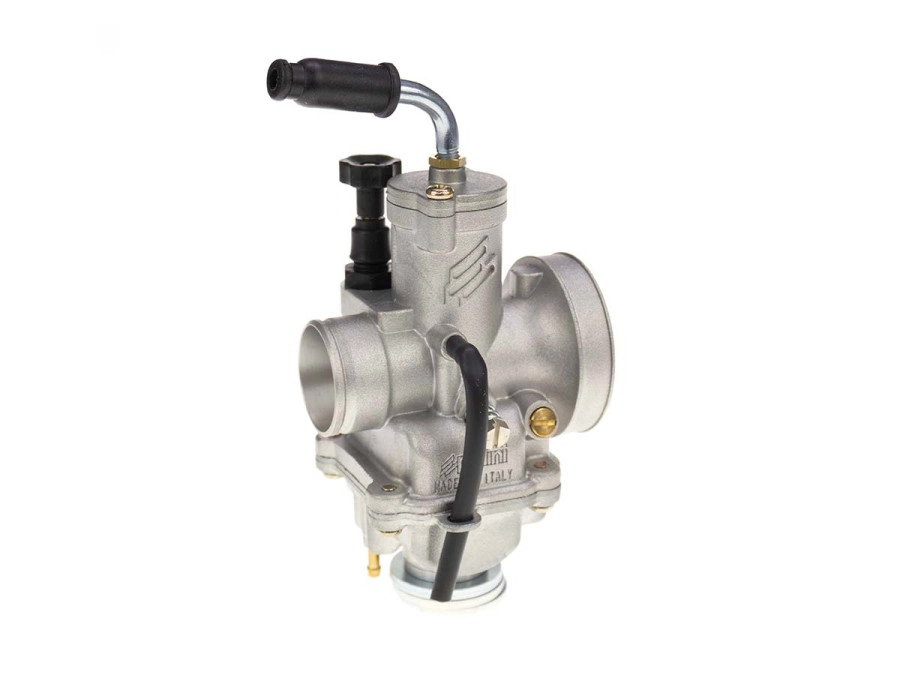
The Polini CP is a needle-type carburetor designed for small engines, scooters, mopeds and racing applications. Like other performance carburetors, it mixes petrol with air before that mixture enters the engine through the intake manifold.
The CP uses several tuning parts to control the mixture at different throttle positions: the float and float needle, idle jet, air screw, throttle slide, conical needle, atomizer, nozzle bush, air brake jet, main jet and choke or starter circuit.
The Polini CP is especially interesting for Puch tuning because it is compact, available in useful sizes and gives more tuning control than a very basic original-style carburetor.
Which Polini CP carburetors does Puchshop sell?
Puchshop stocks the Polini CP range in the sizes most useful for Puch mopeds, from smaller street setups to stronger sport and racing setups. Use the product overview below to compare clamp, spigot, EVO spigot, air filter set and replica options.
 Polini CP EVO spigot carburetors
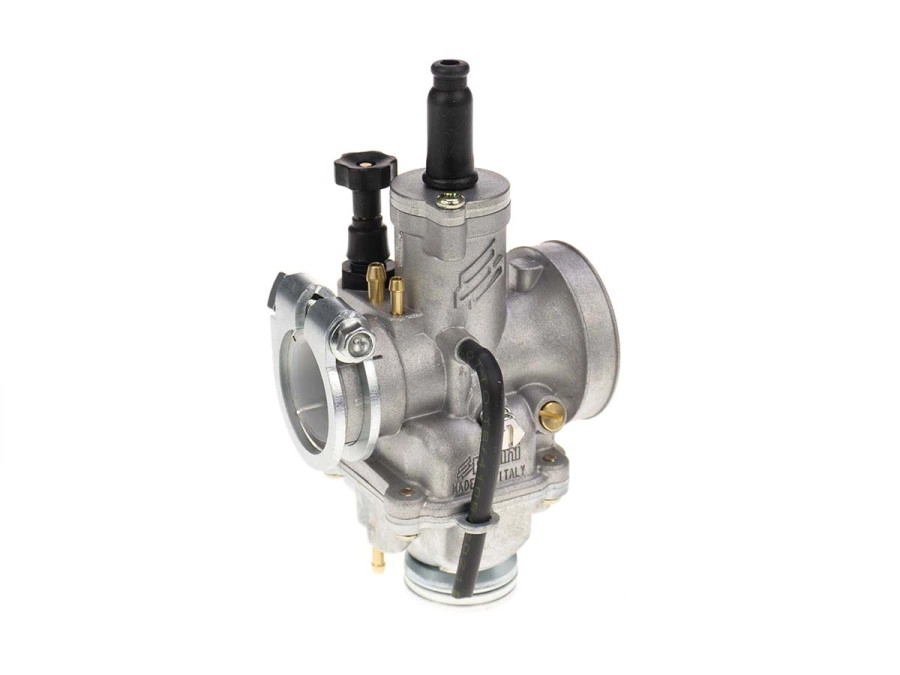 Polini CP clamp carburetors
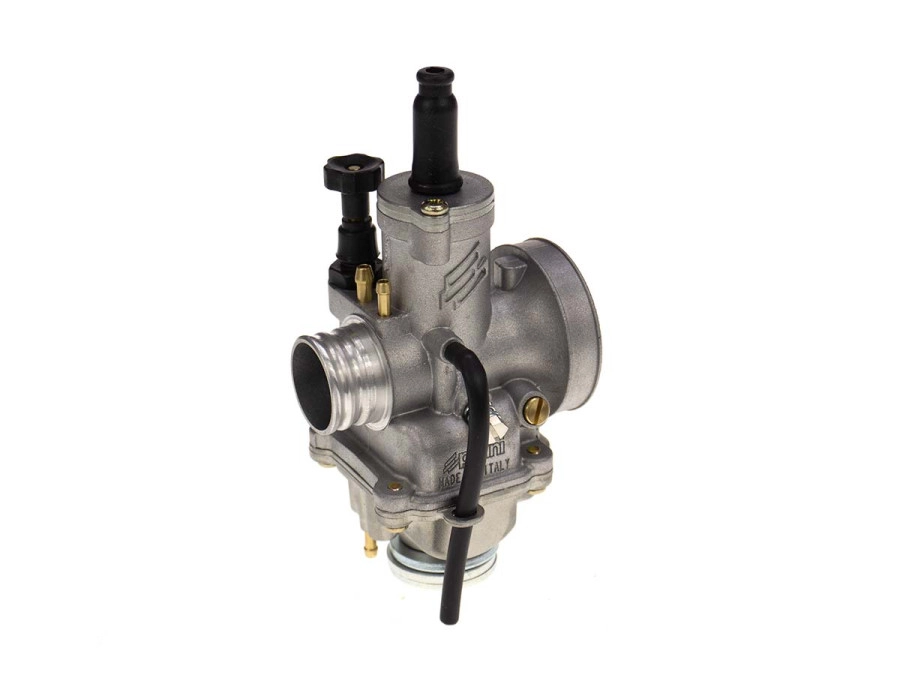 Polini CP spigot carburetors
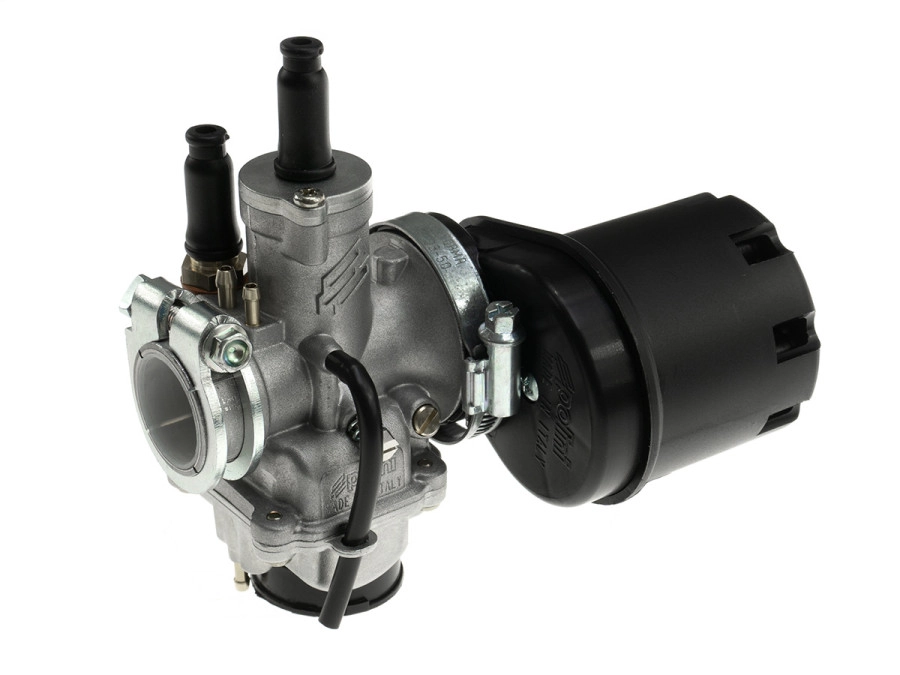 Polini CP carburetor sets
Polini CP EVO manual choke spigot carburetors
| Size | Product | Mounting style | Best use | Shop |
|---|---|---|---|---|
| 19mm | Polini CP EVO 19mm carburetor manual choke spigot | EVO spigot | Strong sport setups where you still want usable throttle response. | View product |
| 21mm | Polini CP EVO 21mm carburetor manual choke spigot | EVO spigot | Tuned 70cc setups with a matching intake and exhaust. | View product |
| 24mm | Polini CP EVO 24mm carburetor manual choke spigot | EVO spigot | High-performance and race-style engines that can use high airflow. | View product |
Polini CP clamp manual choke carburetors
| Size | Product | Mounting style | Best use | Shop |
|---|---|---|---|---|
| 15mm | Polini CP 15mm carburetor manual choke clamp connection | Clamp | Mild 50cc setups and street builds where easy response matters. | View product |
| 17.5mm | Polini CP 17.5mm carburetor manual choke clamp connection | Clamp | Sport 50cc and mild 60cc or 70cc street setups. | View product |
| 19mm | Polini CP 19mm carburetor clamp connection manual choke | Clamp | A strong all-round choice for many tuned Puch engines. | View product |
| 21mm | Polini CP 21mm carburetor clamp connection manual choke | Clamp | Stronger sport setups with enough cylinder and exhaust to use the airflow. | View product |
Polini CP spigot manual choke carburetors
| Size | Product | Mounting style | Best use | Shop |
|---|---|---|---|---|
| 17.5mm | Polini CP 17.5mm carburetor manual choke spigot | Spigot / rubber connection | Street and sport setups using a rubber intake connection. | View product |
| 19mm | Polini CP 19mm carburetor manual choke spigot | Spigot / rubber connection | Sport street setups where vibration isolation and flexible fitment help. | View product |
| 21mm | Polini CP 21mm carburetor manual choke spigot | Spigot / rubber connection | Tuned engines with the intake and exhaust to support more flow. | View product |
Polini CP carburetor sets and extra options
| Size | Product | Mounting style | Best use | Shop |
|---|---|---|---|---|
| 17.5mm | Polini CP 17.5mm carburetor manual choke replica spigot | Replica spigot | Budget-friendly replacement-style option for smaller street and sport setups. | View product |
| 21mm | Polini CP 21mm carburetor cable choke clamp connection with air filter | Clamp with cable choke and air filter | Useful when you want a complete carburetor and air filter combination with cable choke operation. | View product |
| 21mm | Polini CP 21mm carburetor manual choke spigot with air filter | Spigot with manual choke and air filter | Useful when your setup needs a spigot CP carburetor and matching air filter in one kit. | View product |
For related jets, manifolds, filters and spare parts, you can also browse the Polini CP / PWK parts category.
Back to topClamp, spigot and EVO spigot: what is the difference?
The carburetor size is only one part of the choice. You also need the correct mounting style for your intake manifold and frame clearance.
Polini CP clamp
A clamp-style CP carburetor tightens directly around the intake manifold. This can be a clean solution when your manifold and carburetor connection are designed for that style.
- Good when your intake manifold matches the clamp size.
- Useful for mild and sport street setups.
- Simple mechanical connection.
- Check frame clearance for the filter, throttle cable and choke.
Polini CP spigot
A spigot-style CP carburetor slides into a rubber or flexible intake connection. This style is common on tuned engines because it can reduce vibration transfer and gives more flexibility with manifold design.
- Good when your manifold uses a rubber connector.
- Helps with vibration isolation.
- Useful for sport street setups and stronger engines.
- Allows more flexible carburetor positioning.
Polini CP EVO spigot
The EVO spigot versions are the more performance-oriented CP options in the Puchshop range. These are available in 19mm, 21mm and 24mm.
- Best for engines built to make power at higher rpm.
- Needs a cylinder, exhaust and intake that can actually use the extra airflow.
- Requires more careful jetting than a mild street carburetor.
- Best suited for fast sport or race-style setups.
Which Polini CP size should you choose?
Venturi size matters. A larger venturi can reduce restriction and support more power when the engine can use the airflow. A smaller venturi increases air speed and can improve response in the useful rpm range. That means the best carburetor is not automatically the biggest carburetor. The best carburetor is the one that matches your engine.
| CP size | Good starting point for | Character |
|---|---|---|
| 15mm | Mild 50cc setups and small street builds | Easy response, simple street behavior and not a big top-end carburetor. |
| 17.5mm | Sport 50cc and mild 60cc or 70cc setups | Good balance of response, tuning range and street usability. |
| 19mm | Strong 50cc and sport 60cc or 70cc setups | Often a strong all-round choice for tuned Puch engines. |
| 21mm | Tuned 70cc setups with matching exhaust and intake | More airflow and stronger top-end potential, but it needs careful jetting. |
| 24mm | High-performance or race-style setups | Best for engines that can use high airflow and higher rpm. |
How the Polini CP tuning circuits work
A Polini CP carburetor does not run on one jet alone. Different parts of the carburetor affect different throttle positions and engine loads.
| Part | When does it mainly work? | What can you notice with the wrong setup? |
|---|---|---|
| Float and float needle | Constantly, because the float bowl fuel level affects every fuel circuit | Overflowing, flooding, inconsistent mixture or fuel starvation. |
| Idle jet | Idle, closed throttle and the first throttle opening | Bad idle, stalling, hanging idle or poor response from low rpm. |
| Air screw | Idle and low throttle progression | Poor pickup from idle, unstable idle or low-speed lean/rich symptoms. |
| Throttle slide | Controls the available airflow area as the throttle opens | Uneven first response, poor airflow control or incorrect idle speed if not closing correctly. |
| Conical needle | Low-to-mid, midrange and acceleration | Hesitation, bogging, rich blubbering or lean surging at partial throttle. |
| Atomizer / nozzle bush and air brake jet | Fuel-air emulsion through the needle and main system | Hard-to-correct midrange mixture, poor atomization or an engine that feels wrong even with jet changes. |
| Main jet | High throttle and full throttle | Lean running, overheating, four-stroking, poor pulling power or piston damage if too lean. |
Float and fuel level
The float system keeps fuel in the float bowl at a controlled level. On a Polini CP, the float lever arm is calibrated during assembly and is not meant to be adjusted like some other carburetors.
Idle jet and air screw
The idle jet controls fuel when the throttle is closed or almost closed. It also affects the first response when you open the throttle. The air screw fine-tunes the idle and low-throttle mixture. On the Polini CP, screwing the air screw in reduces the air supply and enriches the mixture. Screwing it out increases air and leans the mixture. A basic starting point is about 1 to 1.5 turns open from fully closed.
Conical needle, atomizer and air brake jet
The Polini CP is a needle-type carburetor. As the throttle slide lifts, the conical needle changes the fuel passage through the atomizer. The atomizer and air brake jet influence how fuel and air mix before entering the engine. This makes the CP tunable, but it also means midrange tuning should be done logically and step by step.
Main jet
The main jet controls fuel delivery at larger throttle openings and full throttle. Start with a safe rich main jet and work down carefully. A lean two-stroke setup can overheat, seize or damage the piston.
Back to topPolini CP air brake jet explained
The air brake jet is part of the Polini CP atomizer system. The atomizer is the tube that connects the main jet area to the venturi. Fuel is drawn through the main jet and needle area, while air from the air channel helps mix and pre-atomize that fuel before it is pulled into the engine.
Polini explains in its official CP carburetor instructions that the CP can be set up to work with different atomizer behavior by changing the brake air jet. A closed air brake jet makes the system behave like an atomizer without holes. An open air brake jet lets the atomizer holes work and makes the mixture weaker, or leaner.
| Air brake setup | What it does | What you may notice |
|---|---|---|
| Closed air brake jet | Makes the atomizer system behave more like an atomizer without holes. | Useful as a baseline when you do not want extra air leaning the atomizer system. |
| Open air brake jet | Allows the atomizer holes to work and adds air to the fuel emulsion. | Can make the low-to-mid and mid-throttle mixture weaker or leaner. |
That is why the air brake jet matters when a Polini CP idles correctly and pulls at full throttle, but feels rich, soft, blubbery, or inconsistent in the low-to-mid and mid-throttle range. The air brake jet is not the same adjustment as the air screw: the air screw works on idle and low-throttle progression, while the air brake jet affects the atomizer and needle/main fuel emulsion.
- First check for false air, fuel flow and float condition.
- Check air filter restriction, intake length and fuel hose routing.
- Start with a safe main jet before testing hard under load.
- Set the idle jet, air screw and needle clip before chasing advanced atomizer changes.
Practical rule: leave the standard air brake setup alone until the basic carburetor settings are close. Change only one thing at a time, test with a warm engine and keep a safe rich main jet while you are learning what the setup wants.
Back to topInteractive Polini CP tuning tool
Use the slider below to see which Polini CP carburetor parts have the strongest influence as the throttle opens. This is a simplified learning tool, not a replacement for real test riding, plug checks, temperature checks and safe jetting.
Interactive Polini CP Tuning Simulator
Twist the throttle below to see how the Polini CP idle circuit, throttle slide, needle and atomizer system, air brake jet and main jet hand off fuel-metering responsibility as throttle opening and engine load increase.
Active Polini CP components
- Idle Jet & Air ScrewEstimated influence: 100%Controls idle and very small throttle openings. On a Polini CP, the idle jet and air screw strongly affect starting, idle quality and the first pickup from closed throttle.
Constant systems
Basic Polini CP tuning order
Tuning works best when you follow a clear order. Do not change everything at once, and do not tune around a dirty carburetor, poor fuel flow, false air or ignition problems.
Common Polini CP symptoms and what to check
Carburetor symptoms can overlap with ignition, air leaks, exhaust restriction and fuel supply problems. Use the table below as a starting point, then check the complete engine setup.
| Symptom | Likely area to check | What it can mean |
|---|---|---|
| Engine starts badly when cold | Choke / starter circuit, idle jet, air screw | Not enough enrichment or poor low-speed setup. |
| Engine stalls when you open the throttle | Idle jet too rich, needle too rich, poor fuel atomization | The engine may be loading up before it can clean out. |
| Idle hangs high before settling | Idle jet too small, air screw too far out, air leak | The low-throttle mixture may be too lean. |
| Engine bogs at low throttle | Idle jet, air screw, needle position | The low-speed circuit is not matched to the engine. |
| Engine four-strokes or blubbers at full throttle | Main jet too large, needle too rich | Too much fuel at higher throttle openings. |
| Spark plug is light grey or white | Main jet too small, lean setup, air leak | Dangerous lean condition. Stop and correct before riding hard. |
| Spark plug is wet or sooty | Main jet too large, rich needle, weak ignition | Too much fuel or incomplete combustion. |
| Fuel leaks from the carburetor | Float needle, float, dirt in fuel system | Fuel supply may not be shutting off correctly. |
| Good idle but poor midrange | Needle clip, needle type, atomizer, air brake jet | The mid-throttle circuit needs adjustment. |
| Good low rpm but weak top-end | Main jet, carb size, exhaust, intake restriction | The engine may need more fuel, more airflow or a better matched setup. |
Fitting tips before you ride
Before starting the engine, check that the carburetor is properly fitted and that the throttle and choke operate smoothly.
- The carburetor is tight on the manifold.
- The throttle slide opens fully and snaps closed.
- The throttle cable has a little free play.
- The choke opens and closes fully.
- The fuel hose is not kinked.
- The carburetor does not touch the frame, cylinder, engine case or side cover.
- The air filter is fitted securely.
- The fuel flow from the tank is strong enough.
- The engine has no intake air leaks.
Ready to upgrade your intake?
Find the right Polini CP carburetor and the exact jets, manifolds and filters you need to get your Puch running properly.
View all Polini CP carburetors Start with the right carburetor size, then tune safely from rich toward correct.FAQ: Polini CP carburetors for Puch mopeds
Is a Polini CP better than a Dellorto PHBG?
It depends on the setup. A Dellorto PHBG is very common and has a large tuning-parts ecosystem. A Polini CP is compact, modern and available in useful performance sizes. For many tuned Puch engines, the CP is a strong option when you choose the correct size and mounting style.
What Polini CP size is best for a Puch Maxi?
For many street-tuned Puch Maxi setups, 17.5mm or 19mm is a good place to start. A 21mm carburetor can work well on stronger 70cc setups. A 24mm CP EVO is usually better suited to high-performance or race-style engines.
Should I choose clamp or spigot?
Choose the mounting style that matches your intake manifold. A clamp carburetor tightens directly to the manifold. A spigot carburetor usually mounts into a rubber connection. Spigot mounting can help with flexibility and vibration isolation on tuned setups.
What is the basic air screw setting on a Polini CP?
A good basic starting point is 1 to 1.5 turns open from fully closed. From there, adjust the air screw after the engine is warm and the idle jet is close to correct.
What does the air brake jet do on a Polini CP?
The air brake jet changes how air reaches the atomizer system. A closed air brake jet keeps the atomizer behavior closer to a no-hole atomizer, while an open air brake jet lets the atomizer holes work and leans the mixture. It mainly matters when you are chasing low-to-mid and mid-throttle behavior after the basic jetting is close.
Should I change the air brake jet first?
No. Start with the basics first: clean carburetor, no false air, correct fuel flow, safe main jet, suitable idle jet, air screw setting and needle clip. Only look at the air brake jet, atomizer and nozzle bush when the normal tuning steps do not clean up the midrange.
Should I start with a rich or lean main jet?
Start rich and tune down carefully. Beginning with a larger main jet helps reduce the risk of lean damage, then you can test and reduce step by step.
Can I use a 24mm Polini CP on a 50cc Puch?
You can use a large carburetor only if the rest of the engine setup can use it. On most mild 50cc street engines, a 24mm carburetor is usually too large and can reduce throttle response. It makes more sense on a high-rpm racing