


 Customer service
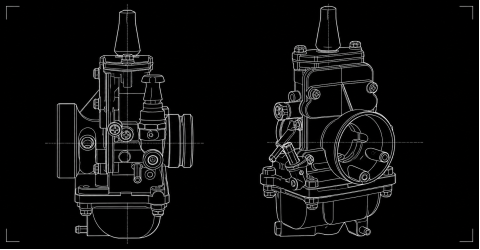
Mikuni TM 24mm Carburetor Explained
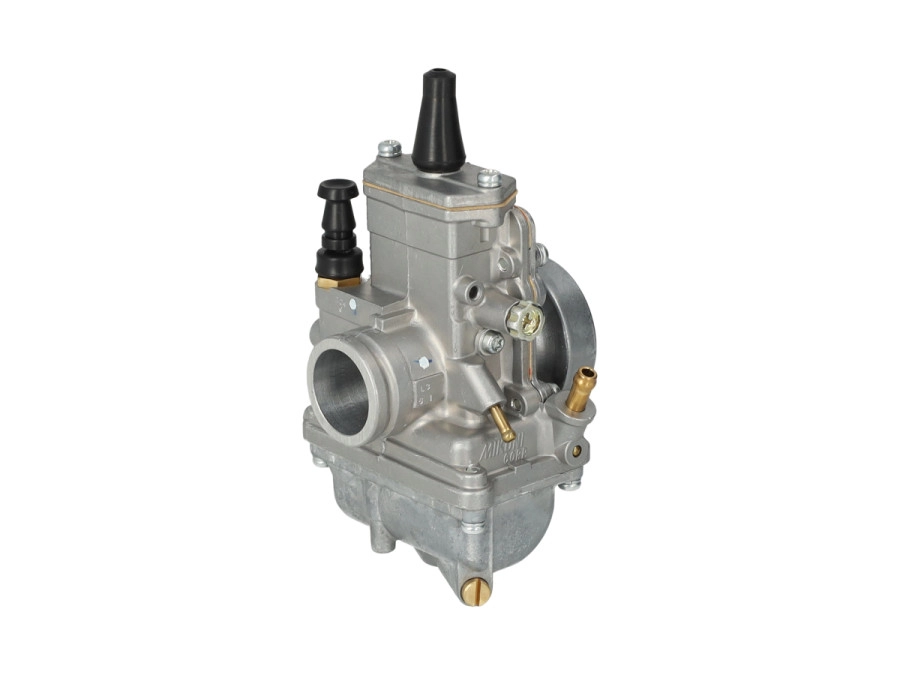
The Mikuni TM 24mm is a flat-slide performance carburetor for tuned Puch mopeds that need more airflow, sharper throttle response and more precise fuel control than a small standard carburetor can provide. Puchshop currently focuses on the Mikuni TM 24mm spigot version with manual choke, so this guide keeps the explanation centered on that model.
A 24mm carburetor is not a magic upgrade for every engine. It works best when the rest of the setup can use the extra airflow: cylinder, exhaust, intake manifold, air filter, ignition and clutch setup all need to match. On the right engine, the Mikuni TM gives a direct, crisp feel. On the wrong setup, it can be harder to tune at low rpm than a smaller carburetor.
What makes the Mikuni TM different?
The main difference is the flat slide. A round-slide carburetor has a curved slide inside the bore. The Mikuni TM uses a flat slide that moves vertically. When you open the throttle, the slide uncovers the venturi and the needle rises out of the needle jet. Air speed increases, fuel is drawn from the jets and the engine receives the mixture it needs for that throttle position.
For a moped rider, the important feeling is response. A well-set Mikuni TM reacts quickly when you open the throttle. The engine should not feel lazy, wet or delayed. That is why this type of carburetor is interesting for sport and race-style Puch builds, especially when a larger cylinder and freer exhaust are already fitted.
Mikuni TM 24mm technical details
Use the table below as practical review information before choosing parts for your setup. The catalog jetting values are useful for identifying the carburetor, but they should not be treated as guaranteed plug-and-play Puch jetting. Final jetting always depends on the exact cylinder, exhaust, air filter, fuel flow, ignition timing and riding load.
| Item | Detail | What it means |
|---|---|---|
| Puchshop product focus | Mikuni TM 24mm spigot carburetor with manual choke | This article focuses on the Mikuni TM 24mm model currently sold by Puchshop. |
| Mikuni model reference | TM24-8001 | Official Mikuni 24mm TM flat-slide reference. |
| Carburetor type | Flat-slide, variable-venturi carburetor | The throttle slide opens the air passage and lifts the needle from the needle jet. |
| Catalog main jet | 4/042 #130 | Starting information only. Your Puch setup may need a different main jet. |
| Catalog pilot jet | VM22/210 #15 | Controls idle and the first part of throttle opening. |
| Needle jet / series | 784-21005-Q-0 / 454 | Works with the jet needle for mid-throttle fuel control. |
| Catalog jet needle | 5N13 | Needle taper helps control the mid-range fuel curve. |
| Catalog throttle slide | 832-30005-3.0 | Slide cutaway influences first throttle response. |
| Catalog air jet | None listed for TM24-8001 | Do not tune this carburetor as if it has every external adjustment found on other models. |
| Fitment detail | 31mm inlet / approximately 45mm airbox side | Check your manifold rubber, air filter connection and available frame space before fitting. |
| Shop the product | Puchshop Mikuni TM 24mm | View Mikuni TM 24mm carburetor |
How does the Mikuni TM 24mm work?
A carburetor does not use one fuel circuit for every riding situation. In carburetor language, a circuit means a fuel and air pathway with its own jets, screws, passages or ports. These circuits overlap as the throttle opens. The Mikuni TM 24mm should be understood as a system: the float bowl keeps fuel available, the pilot circuit controls the first part of the throttle, the flat slide and needle handle the transition and mid-range, and the main jet dominates at high throttle.
| Throttle area | Main active parts | What is happening |
|---|---|---|
| Cold start | Manual choke / starter enrichment circuit, pilot system | Extra fuel helps a cold engine start. Switch off the starter enrichment once the engine warms and accepts throttle cleanly. |
| Idle to 1/8 throttle | Pilot jet, pilot/mixture screw, idle screw, slide height | This area decides how the engine idles and how cleanly it picks up from a stop. |
| 1/8 to 1/4 throttle | Pilot system and slide cutaway | The flat slide begins to uncover the venturi; cutaway shape affects the first response. |
| 1/4 to 3/4 throttle | Jet needle and needle jet | The needle taper meters fuel through the needle jet during normal acceleration and part-throttle cruising. |
| 3/4 to full throttle | Main jet, needle jet, float bowl fuel supply | The main jet becomes the dominant fuel restriction. Tune this area safely rich first. |
Interactive Mikuni TM tuning graph
Use the slider below to see which Mikuni TM 24mm carburetor parts have the strongest influence as the throttle opens. This is a simplified learning tool. The real carburetor circuits overlap, and final tuning must still be tested on your exact Puch setup.
Interactive Mikuni TM Tuning Simulator
Twist the throttle below to see how the Mikuni TM pilot circuit, flat slide cutaway, jet needle, needle jet and main jet hand off fuel-metering responsibility as throttle opening and engine load increase.
Active Mikuni TM components
- Pilot Jet & Pilot/Mixture ScrewEstimated influence: 100%Controls idle and very small throttle openings. If the engine stalls, hangs, starts badly, or reacts poorly just off idle, inspect the pilot circuit first.
Constant systems
Basic tuning order for the Mikuni TM 24mm
Tune the Mikuni TM 24mm in a logical order. If you chase random symptoms without first checking the engine and fuel system, you can waste time changing jets while the real problem is false air, poor fuel flow, weak ignition or an unsuitable intake setup.
Common symptoms and where to look
| Symptom | Likely area to inspect | What to check first |
|---|---|---|
| Hard cold starting | Starter enrichment, pilot circuit, fuel supply | Check choke/enrichener use, pilot jet cleanliness, idle setting and fuel flow. |
| Poor idle or stalling | Pilot jet, pilot/mixture screw, idle screw, false air | Check for intake leaks before assuming the jet size is wrong. |
| Bog just off idle | Pilot circuit and slide cutaway | Check low-speed mixture, slide response and whether the carburetor is too large for the setup. |
| Flat or uneven mid-range | Jet needle, needle clip, needle jet | Move in small steps and test the same throttle range under load. |
| Four-stroking or wet running at full throttle | Main jet, air filter, exhaust match | The main jet may be too rich, but confirm the engine clears out under load before going smaller. |
| Hot, weak or lean feeling at full throttle | Main jet, fuel flow, false air, ignition timing | Stop testing and return to a safer rich setup before continuing. |
Recommended Mikuni TM parts and accessories
A Mikuni TM setup needs more than just the carburetor. You need the correct carburetor, suitable jets, proper manifold fitment, enough fuel flow and the right choke operation for your frame and riding style.
| Part | Why it matters | Shop |
|---|---|---|
| Mikuni TM 24mm carburetor spigot manual choke | The main flat-slide carburetor for tuned Puch engines that can use the extra airflow. | View carburetor |
| Polini / Mikuni jet kit 80-125 | Gives you a useful jet range for safe main-jet testing instead of guessing with one jet. | View jet kit |
| Mikuni TM cable choke conversion | Useful when the manual choke is hard to reach after the carburetor is fitted in the frame. | View choke conversion |
| Manifold, rubber connection and air filter | The TM24 must mount straight, seal properly and receive enough clean airflow. | View carburetor parts |
When is a 24mm Mikuni a good choice for a Puch?
The Mikuni TM 24mm makes the most sense on a tuned Puch setup where the engine can actually move enough air to use the carburetor size. Think of stronger 50cc race-style builds, 65cc to 70cc sport setups and engines with a suitable intake, exhaust and ignition setup. It is usually too much carburetor for a completely standard low-power setup.
Before fitting it, check the intake manifold diameter, rubber connection, throttle cable length, manual choke access, fuel hose routing and air filter space. The product is a spigot type carburetor, so the rubber/manifold connection must fit correctly and seal properly. False air at the intake will make tuning almost impossible.
Building a stronger Puch setup?
The Mikuni TM 24mm is a serious flat-slide carburetor for tuned engines that can use the extra airflow.
View the Mikuni TM 24mm Check manifold, air filter and cable fitment before ordering.FAQ: Mikuni TM 24mm carburetor
Is the Mikuni TM 24mm good for every Puch?
No. It is mainly a performance carburetor for tuned engines. A stock or mild setup may run better and tune more easily with a smaller carburetor.
Is the Mikuni TM 24mm plug and play?
No carburetor is truly plug and play on a tuned two-stroke. You still need the correct manifold, air filter, throttle cable, fuel supply and jetting.
Why does a flat slide respond faster?
The flat slide creates a cleaner air path as the throttle opens. That can increase air speed and improve the signal at the needle jet, which helps fuel metering and throttle response.
Which jet should I use in my Puch?
There is no one correct jet for every Puch. Cylinder, exhaust, air filter, ignition, fuel flow and riding load all matter. Start safely rich and tune step by step.
Should I tune the main jet first?
Start safe with the main jet so the engine is protected, but do not ignore the pilot circuit and needle. A bad low-throttle setup will not be fixed by changing only the main jet.
What does the manual choke do on the Mikuni TM?
The manual choke works as a starter enrichment system. It adds extra fuel for cold starting. Once the engine is warm and accepts throttle cleanly, turn it off.