


 Customer service
Maximum power for 2-strokes: the squish explained
Squish is one of the most important measurements in a tuned two-stroke top end, but it is also one of the easiest numbers to copy without enough context. A clearance that works in a race engine is not automatically suitable for a street Puch expected to run reliably for thousands of kilometers.
Squish clearance is the smallest distance between the outer area of the piston crown and the squish band in the cylinder head when the piston is at top dead center. A well-matched squish setup can promote mixture movement toward the combustion chamber, support a fast and controlled burn, and improve throttle response. A poor setup can leave performance on the table or, if the clearance is too tight, allow the piston to touch the head.
The correct result depends on the complete engine: cylinder, piston, cylinder head, gaskets, connecting rod, crankshaft, bearings, ignition timing, carburetor jetting, exhaust, fuel, cooling, rpm, and intended service life. Squish is therefore part of a complete setup, not a single tuning shortcut.
Quick answer: Approximately 1.0–1.4/1.5 mm is a practical reliability-focused starting range for many street Puch setups. Around 0.8 mm belongs to carefully prepared race-engine territory. These are not universal specifications. Always measure your assembled engine and leave a safety margin that suits the parts, rpm, temperature, and maintenance schedule.
What is squish on a two-stroke engine?
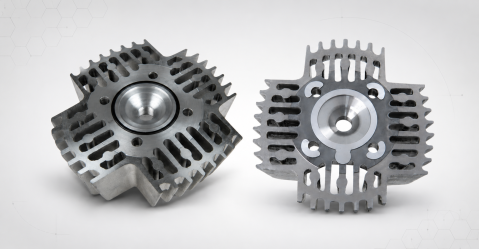
The underside of a two-stroke cylinder head normally has a central combustion chamber and a flatter outer ring called the squish band. As the piston approaches top dead center, the mixture above the outer part of the piston is pushed inward toward the combustion chamber.
The minimum clearance between the piston crown and this squish band is the squish clearance. It is not the same as the distance between the cylinder and cylinder head, and it is not simply the piston’s position relative to the cylinder deck. Deck height, piston shape, gasket thickness, and head geometry all contribute to the final piston-to-head clearance.
Any head gasket, O-ring arrangement, or sealing spacer required by the setup must be included when measuring. Not every Puch cylinder-head combination uses a separate head gasket, so assemble the top end exactly as it will be run.
Back to topWhy squish clearance matters
As the piston rises, the squish band pushes mixture toward the center of the chamber. Correctly matched geometry can create useful mixture movement and support more consistent combustion. That can contribute to improved response, efficiency, and power.
The word “matched” matters. Reducing clearance also changes the combustion conditions and may increase the effective compression of the setup. Squish must work together with the combustion-chamber volume, piston crown, ignition timing, carburetor jetting, exhaust, fuel octane, cooling, and expected rpm.
If the clearance is too large, the squish action becomes less effective. If it is too small, normal movement and expansion at operating speed can reduce the real running clearance enough for the piston to contact the head. Connecting-rod stretch, bearing clearance, crankshaft movement, piston rock, heat, carbon buildup, and manufacturing tolerances all reduce the available safety margin.
Interactive two stroke squish visualizer
Move the piston toward top dead center to see how the mixture above the squish band is pushed inward toward the combustion chamber. You can also compare different installed squish clearances.
Piston low in the cylinder
Street focused reference- Cylinder volume: There is still a large space above the piston.
- Mixture position: The fuel and air mixture occupies the bore above the piston.
- Squish action: The piston is too far from the cylinder head for meaningful squish action.
- Selected clearance: This falls within the practical reliability focused reference range used for many street Puch setups.
Measure and adjust your squish setup
What is a good squish clearance for a Puch?
There is no single squish number that is correct for every Puch cylinder and head combination. The intended use and service interval matter as much as the desired power.
| Intended use | Working reference | Practical interpretation |
|---|---|---|
| Street moped | Approximately 1.0–1.4/1.5 mm | A reliability-focused working range for many road setups. Confirm the exact cylinder-head instructions and measure the finished engine. |
| Tighter street setup | Around 1.0 mm | A possible road setting when the complete engine has been measured and verified. It is not a universal target. |
| Race engine | Around 0.8 mm | Advanced race territory with tighter inspection and rebuild intervals. Do not copy this value without checking the complete engine. |
| Very tight water-cooled race setup | Around 0.6 mm | An extreme value, not a general Puch recommendation. It requires specialist engine design, measurement, testing, and maintenance. |
Most cylinder and cylinder-head suppliers leave more clearance than an all-out race tuner might use. That margin helps account for production tolerances, different pistons and gaskets, heat, wear, and customers who expect a road engine to last much longer than a race engine.
For a street Puch, a slightly larger but verified clearance is normally a better choice than chasing the smallest possible number. For a race engine, the final value should be established by an experienced tuner who can also check combustion-chamber volume, ignition, fuel, temperature, piston condition, and the engine after running.
Back to topHow to measure squish with solder
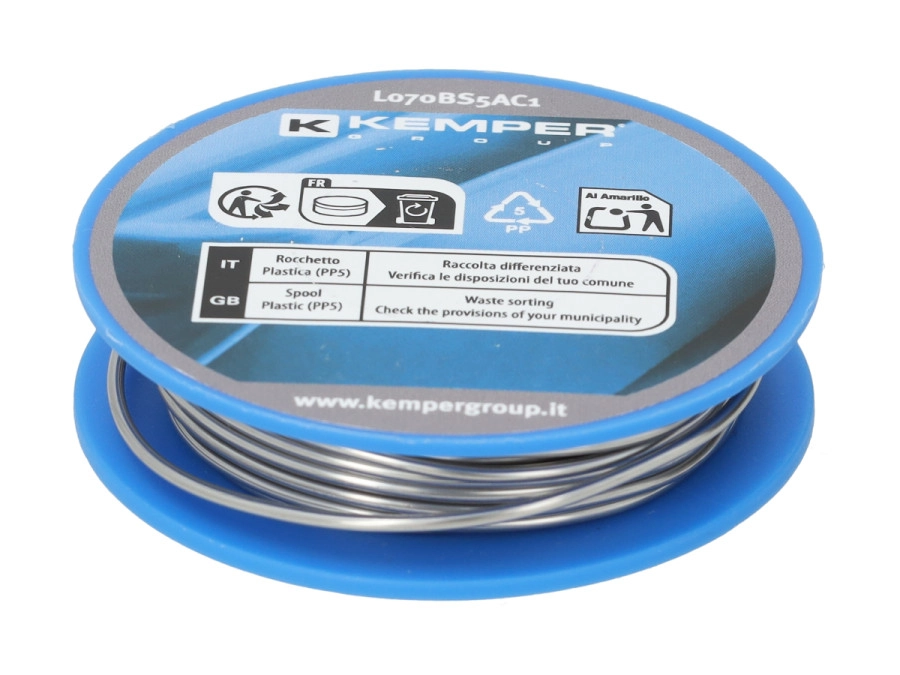
The solder method lets you measure the actual piston-to-head clearance with the top end assembled. Use soft solder that is slightly thicker than the expected clearance and a good caliper or micrometer. Do not use solder that is so thick or hard that forcing it through top dead center places unnecessary load on the engine.
What you need
- Soft solder of a suitable diameter
- A caliper or micrometer
- The correct spark-plug tool
- A way to rotate the crankshaft slowly by hand
- The correct cylinder-head torque information for your setup
Measurement steps
- Work on a cold engine. Switch off the ignition, remove the spark-plug cap, and remove the spark plug.
- Make sure the cylinder head is installed with the correct gasket or O-ring arrangement and tightened evenly to the correct specification.
- Bend a short piece of solder so it can pass through the spark-plug hole and reach the outer part of the bore. The end must lie over the squish band near the cylinder wall, not only in the center of the combustion chamber.
- Hold the solder in position and rotate the engine slowly through top dead center. Turning the flywheel or crankshaft by hand gives the most control. A kickstarter can also be used if it allows the crankshaft to move slowly and any unusual resistance can be felt immediately.
- Remove the solder and inspect the flattened section. Measure the thinnest properly crushed area with the caliper.
- Repeat the measurement on the opposite side and, where the spark-plug angle allows it, at more than one position around the bore. Compare the readings instead of trusting one piece of solder.
- Use the smallest repeatable reading as the critical clearance. If the measurements differ noticeably, investigate head seating, gasket condition, cylinder alignment, piston rock, or an uneven sealing surface before tuning further.
- Remove every piece of solder and confirm that nothing remains in the combustion chamber before refitting the spark plug.
Important: Never start the engine with solder inside it. If the crankshaft becomes abnormally difficult to rotate during the test, stop and use thinner or softer solder rather than forcing it.
How can squish clearance be adjusted?
Squish should only be adjusted after the current setup has been measured accurately. Change one thing at a time, record the gasket thicknesses, and measure again after every change.
Base-gasket thickness
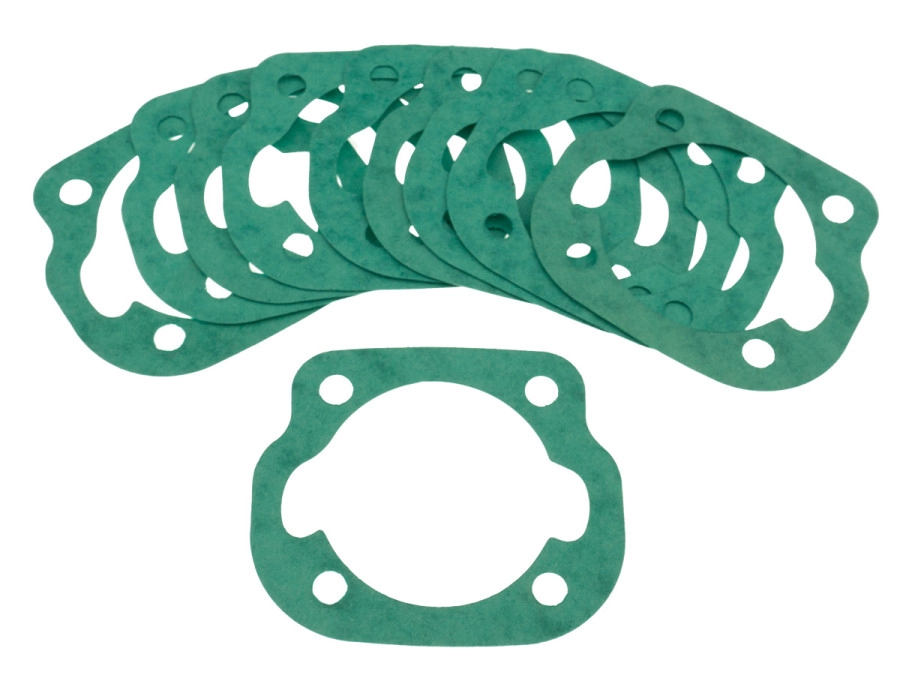
A thicker base gasket raises the cylinder and normally increases squish clearance. A thinner base gasket lowers the cylinder and normally reduces it. This also changes the cylinder’s position relative to the piston and therefore changes the port timing. A base-gasket change is not only a squish adjustment.
Before using the base gasket to alter clearance, check piston position at top dead center and bottom dead center, port opening, cylinder-deck clearance, and sealing. A change that produces the desired squish number can still make the rest of the cylinder timing worse.
Head gasket or head spacer
Where the cylinder-head design uses a separate head gasket or approved spacer, changing its thickness can alter piston-to-head clearance without moving the cylinder ports. It also changes combustion-chamber volume and compression. Use only a sealing method suitable for the exact head and cylinder.
Machining the cylinder head or cylinder
Machining can correct the squish-band angle, clearance, width, or combustion-chamber volume, but these dimensions must be considered together. Removing material without measuring the chamber can create excessive compression, an incorrect band angle, or insufficient running clearance.
Do not hand-sand a cylinder head as a shortcut to a target number. If the engine needs machining, use a tuner or machine shop that understands two-stroke head geometry and can check the finished chamber volume and sealing surface.
Back to topPiston crown and squish-band angle
Clearance alone does not describe the complete squish setup. The squish band should also suit the piston crown. If their angles do not match, the clearance can vary across the width of the band even when one solder reading looks acceptable.
Many common Puch pistons use a domed crown of roughly 11–12 degrees. The relevant PSR and Athena cylinder heads use a squish-band angle around 11.5 degrees as a practical match for those pistons. Some Wössner and racing pistons use a different or flat crown.
These figures apply only to the specific part geometries described above. Always check the piston and cylinder-head combination in front of you. A product name, bore size, or advertised displacement does not guarantee matching geometry.
Back to topSquish-band width is not squish clearance
Squish-band width is the distance from the cylinder wall toward the combustion chamber. Squish clearance is the vertical piston-to-band distance at top dead center. They affect one another, but they are different measurements.
A frequently repeated internet rule says the squish band should be 50% of the bore. Do not treat this as a fixed rule. The best width depends on the chamber shape, bore, stroke, piston crown, rpm, fuel, ignition, cooling, and desired power curve. In practical dyno testing, an effective band is often narrower than a simple 50% rule suggests.
Squish-band width is a cylinder-head design decision, not a normal gasket adjustment. Comparing widths properly requires more than one head, repeatable dyno testing, temperature and detonation control, and inspection of the piston and head after testing.
Back to topSquish, detonation, and engine damage
Detonation is abnormal combustion that can quickly damage a two-stroke piston and cylinder head. Warning signs can include metallic pinging under load, abnormal heat, loss of power, or a peppered pattern of small pits on the piston crown or combustion chamber. A noisy two-stroke does not always make detonation easy to hear, so do not rely on sound alone.
Squish is only one factor. Excessive compression, ignition that is too far advanced, a lean fuel mixture, inadequate fuel octane, cooling problems, air leaks, and sustained high temperature can all contribute to detonation.
Small pits or impact marks can also be caused by debris from a failed needle bearing or another damaged part. If you find marks in the cylinder head, stop running the engine and inspect the piston, rings, small-end bearing, spark plug, cylinder, and combustion chamber before deciding on the cause.
Physical contact usually leaves cleaner witness marks where the piston or carbon has touched the squish band. Any suspected contact means the clearance, bearings, crankshaft, connecting rod, piston, gasket stack, and carbon buildup must be checked before the engine runs again.
Back to topStreet reliability or maximum race performance?
Off-the-shelf parts are generally designed to work reliably across a range of normal street engines. A dedicated race tuner may machine and test the same basic parts to extract the final percentage of performance.
That final percentage comes with tradeoffs. A race engine may use tighter clearances, higher rpm, more frequent inspections, and much shorter rebuild intervals. A street moped needs room for heat cycles, wear, fuel variation, long full-throttle runs, and normal maintenance intervals.
For most road builds, the goal is not the smallest squish number. The goal is a measured, repeatable clearance that works with the complete setup and provides the desired performance without sacrificing the reliability expected from the engine.
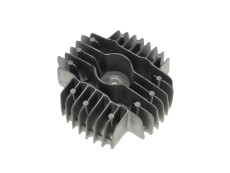
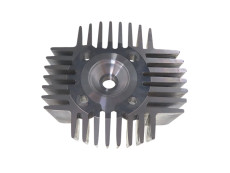
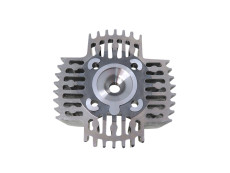
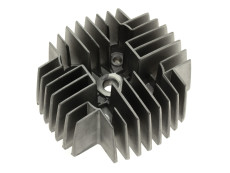
Choose a cylinder head for your Puch setup
Browse cylinder heads for standard replacement, street tuning, and performance builds.
Shop all Puch cylinder heads Always confirm compatibility with your cylinder, piston, bore, and cooling setup.FAQ: two-stroke squish clearance
What is squish clearance on a two-stroke?
Squish clearance is the minimum distance between the piston crown and the squish band in the cylinder head when the piston is at top dead center. It is measured on the assembled engine and includes the effect of the complete gasket or O-ring arrangement.
What squish clearance should I use on a street Puch?
Approximately 1.0–1.4/1.5 mm is a practical reliability-focused starting range for many street Puch setups. It is not a universal specification. Check the instructions for your exact cylinder, piston, and head, then measure the assembled engine.
Is 0.8 mm squish safe for a Puch?
Around 0.8 mm is race-engine territory. Whether it is safe depends on the complete engine, rpm, temperature, bearings, crankshaft, connecting rod, piston, carbon buildup, fuel, and service interval. Do not use a race value blindly on a street engine.
Does a smaller squish clearance always make more power?
No. Reducing clearance can change mixture movement and compression, but too little clearance risks piston contact and may create harmful combustion conditions. The squish-band angle, width, chamber volume, ignition, jetting, exhaust, and fuel must all work together.
Can I measure squish through the spark-plug hole?
Yes. Insert suitable soft solder through the spark-plug hole so it reaches the squish band near the cylinder wall, rotate the engine slowly through top dead center, and measure the crushed solder. Repeat the test in more than one position when possible.
Does the head gasket count when measuring squish?
Yes. Measure the engine with the exact head gasket, O-ring, spacer, or other approved sealing arrangement it will use. Not every Puch setup uses a separate head gasket.
Is squish the same as compression ratio or deck height?
No. Squish is piston-to-head clearance at the squish band. Deck height describes the piston’s position relative to the cylinder deck, while compression ratio also depends on the total combustion-chamber volume. Changing one measurement can affect the others, but they are not interchangeable.